Solidarity instead of Pessimism
Amid wars, crises, and polarization, calls for solidarity are becoming ever louder. Yet the world seems largely unimpressed. A new research network is dedicated to exploring the significance of solidarity in today’s world.
The year 2026 got off to a turbulent start. Faced with geopolitical escalation and media-driven generational bashing, the glue that holds our social order together appears to be crumbling. We have grown accustomed to it. In recent years, though it is difficult to say exactly since when, one piece of bad news has followed another. We are confronted with military conflicts, the fragmentation of civil society, divided political camps, growing economic pressure, and environmental crises. Driven by headlines and sensationalist commentary, we rush from one outrage to the next. Quiet moments to pause and regain our bearings are increasingly rare. And amid all this, one demand keeps resurfacing: “Show solidarity!” But do we still know how to practice solidarity?

“I have become less emotionally driven in my solidarity. I want to address structural issues. As a result, the solutions don’t come quickly.”Maria Jastrzebska
“I believe that the older I have become, the less spontaneous, emotional, or euphoric my sense of solidarity has become,” says Maria Jastrzebska. “I’ve noticed that many issues need to be resolved at levels that have little to do with individual encounters or relationships.” Maria Jastrzebska is a member of the newly founded Solidarity Research Network (SRN). Together with researchers from around the world, she aims to gain a better understanding of what characterizes solidarity today. This effort is also linked to the hope of offering an alternative to the prevailing sense of hopelessness. “Solidarity can be briefly described as standing up for one another. It is fundamentally not profit-oriented, although it may manifest itself through material support. Solidarity goes beyond immediate benefits. It is relational, embedded in reciprocal relationships, even if at certain moments it may initially appear one-sided,” she explains.
Is solidarity given?
“Standing up for one another” sounds simple enough. And indeed, solidarity is often perceived as straightforward: those who are poor, oppressed, voiceless, or wronged are considered deserving of solidarity. Yet such perceptions depend on personal history, life experiences, values, and political convictions. “In Ukraine, the concept of solidarity was heavily stigmatized because of the Soviet Union,” says Dr. Petro Mozolevskyi. Together with Maria Jastrzebska, Prof. Dr. Thomas Geisen, and other colleagues from the FHNW School of Social Work, he launched the SRN one year ago. “But when the war began, I experienced just how much solidarity we received from abroad. And ever since then, I have found it inspiring and have wanted to broaden and return solidarity wherever possible,” Dr. Mozolevskyi continues. His commitment to strengthening solidarity through the SRN stems directly from this experience and demonstrates how contagious solidarity can be. The network now consists of 38 members from universities and higher education institutions around the world. International exchange lies at the heart of both the project and solidarity itself. In the context of globalization and increasingly individualized life paths, it has become more difficult to identify a shared, universally accepted basis for solidarity in action and sentiment.
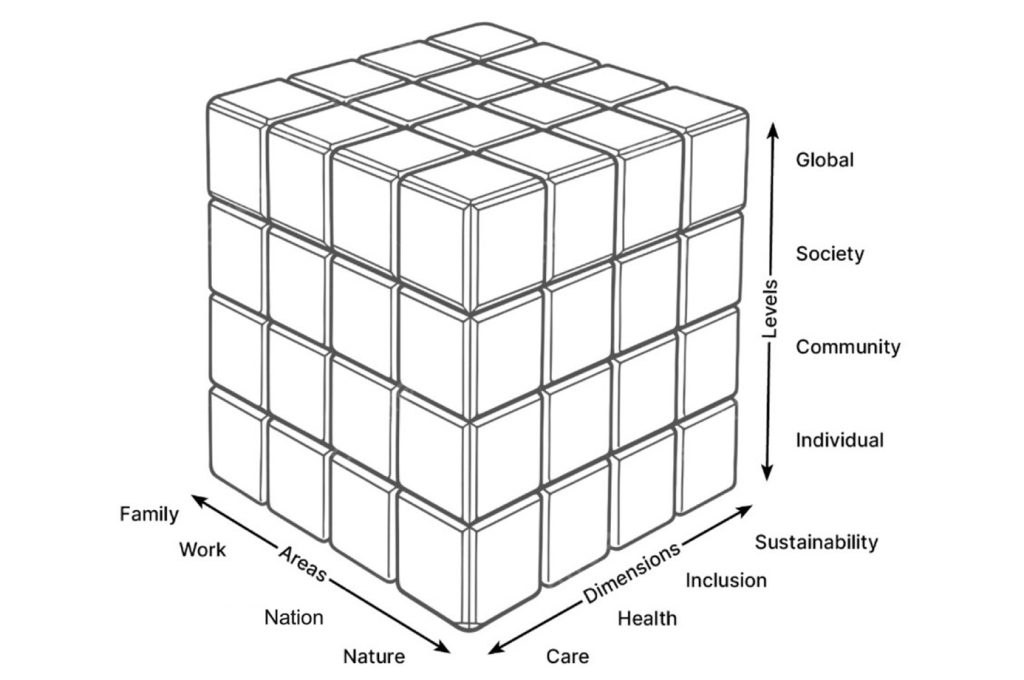
Just how complex solidarity can be is illustrated by an initial model developed by the Solidarity Research Network, which outlines its areas of interest. It quickly becomes apparent that many fields of activity and institutional arrangements are based on the principles of solidarity, even if this is not explicitly acknowledged: family relationships, welfare systems, and concern for the environment are just a few examples. One goal of the SRN is to better understand these dimensions. What norms and practices exist? Where do we see continuity, and where is solidarity changing? The international perspective is crucial. We live in a globalized world in which problems, conflicts, and challenges transcend national borders.
The limits of solidarity
Despite its many dimensions and connections, solidarity also has its limits. One limitation is particularly evident in today’s global situation: it can become overwhelming. Rates of exhaustion, hopelessness, lethargy, and radicalization have reached unprecedented levels. The pressure to constantly demonstrate solidarity can itself become burdensome and numbing. “The concept of solidarity is highly emotional and politically charged, and it is often exploited for political purposes. Nowadays, with all these wars and crises, every other word seems to be ‘solidarity’. That can be unsettling,” says Maria Jastrzebska. While emotions certainly motivate acts of solidarity, fear, anger, and pain reflect shared experiences and connect people. Yet therein also lies the danger of burning out. “We cannot always show the same intensity and level of solidarity for everyone. I have to set limits regarding where and how I get involved,” Maria adds.

“The situation in the world troubles me. There are so many conflicts and wars. I see that the major powers are not interested in showing solidarity but rather in demonstrating strength. That is the wrong direction.”Dr. Petro Mozolevskyi
Another boundary emerges when solidarity turns into something else entirely, when supposed solidarity results in new forms of suffering. “At what point does a certain form of cohesion cease to be solidarity? Are radicalized and violent groups acting in solidarity, for example? No. Once violence enters the picture, it is no longer solidarity – we discussed this with Prof. Dr. Thomas Geisen. Violence changes people in such a way that the resulting structures become forms of domination rather than solidarity,” explains Maria Jastrzebska.
Between such big questions and the many small moments of solidarity in action, the Solidarity Research Network seeks to better understand how solidarity is perceived today. An important part of this effort is exploring how solidarity is practiced in Social Work and what opportunities exist to foster a solidarity among people and society.
Solidarity-based work instead of Social Work?
Social Work can be understood as a field fundamentally rooted in solidarity. The Code of Ethics for Social Work explicitly mentions solidarity in connection with both collective responsibility and social justice. People are always part of social and ecological systems. Within these systems, individuals possess differing opportunities and resources. One of the central tasks of Social Work is to support those with fewer opportunities in a solidaristic manner while simultaneously promoting awareness of responsibility toward others and the broader community, thereby strengthening systems of solidarity. What this means in practical terms is one of the questions explored by the SRN.
Welfare states and norms of solidarity are built on political participation, social justice, and cultural self-determination, but the development of solidarity is neither inevitable nor linear. Engaging critically with solidarity is essential if we are to find viable and sustainable forms of coexistence in the face of current ecological, economic, cultural, and social crises and conflicts. “It is incredibly important to demonstrate that solidaristic action is still possible. The international network plays a crucial role here. We find allies and can discuss our perspectives broadly. At the same time, cooperation within this research network is itself an expression of solidarity, supporting one another for the sake of a shared cause rather than for material gain,” says Dr. Petro Mozolevskyi.
Solidarity can serve as a framework for Social Work that strengthens professional practice and supports the development of sustainable solutions. At the same time, there is a risk of overload, emotional strain, and exhaustion. Perhaps that is precisely where its strength lies: taking action despite feeling overwhelmed, despite exhaustion. Even if the action is small, it allows people to experience their own agency and impact. That sense of effectiveness is liberating and encouraging. Creating opportunities for others to experience the relevance of their own actions and to pass solidarity on, or return it, may be one way to ease both personal circumstances and emotional burdens. The research network sees itself as an example of exactly this: solidaristic research as a lived response to the questions it seeks to answer. Being in solidarity with others may also mean being in solidarity with oneself.
Comments
No comment posted about Solidarity instead of Pessimism